The Idea
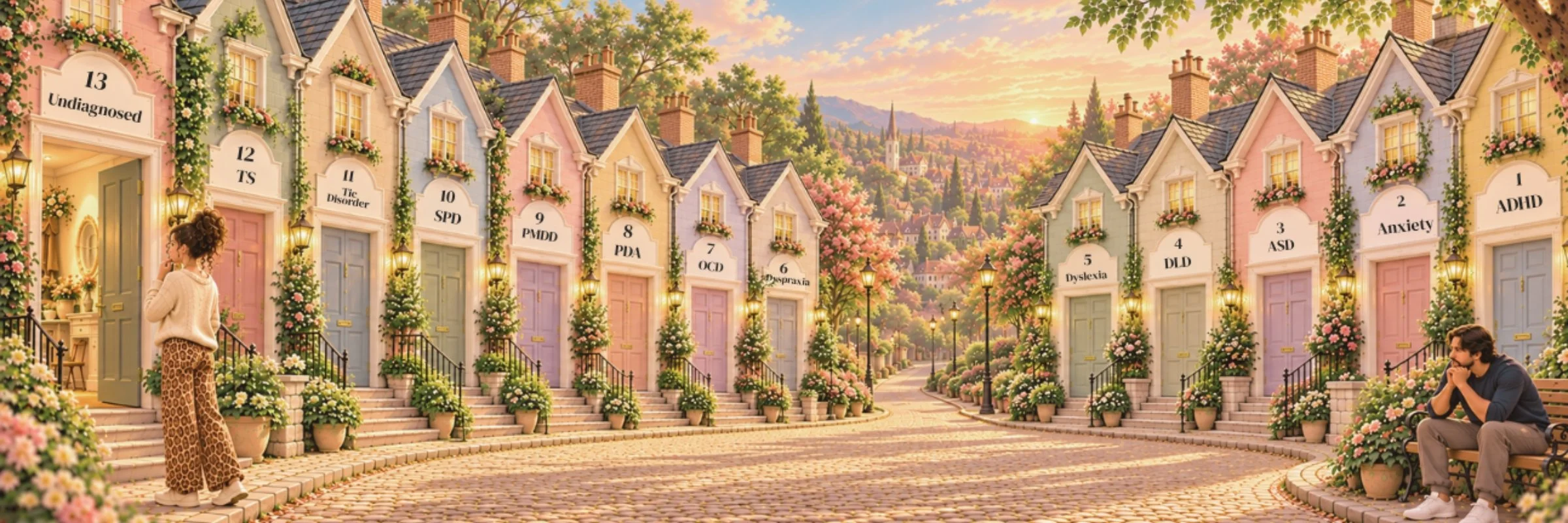
We came up with this street to explain things to our children. This is a way to explain things, not a way to diagnose them.
Each house is a condition or diagnosis. Each house has furniture inside, and the furniture is the traits: the things you might notice, like needing quiet or finding change hard.
Different houses can have similar furniture. That’s why conditions can look alike, and why one can sometimes be mistaken for another.
How To Read The Street
Every house is a condition.
The furniture inside is the traits.
Two houses can have the same sofa, so having a trait doesn’t mean you live in that house.
You might live in one house with furniture from a few others, or in several.
That overlap is why conditions can be hard to tell apart.
Even in the same house, no two people’s furniture is quite the same.
The open door at number 13 is for anyone who is undiagnosed.
No Label Needed
Not every condition has an official label in the UK, and not everyone has been assessed. That doesn’t make what you’re living with any less real or valid. You’re welcome even without the paperwork.
What The Letters Mean
ADHD: attention deficit hyperactivity disorder
ASD: autism spectrum disorder
DLD: developmental language disorder
OCD: obsessive compulsive disorder
PDA: pathological demand avoidance or pervasive drive for autonomy (a profile described within autism, not a formal diagnosis from the DSM-5 or ICD-11)
PMDD: premenstrual dysphoric disorder
SPD: sensory processing differences
TS: Tourette's syndrome
Tic Disorder: includes motor and vocal tics, with or without Tourette's